

Three.js · WebGL · 3D configurators
3D configurator development with Three.js and WebGL
In shortWeDevelop is a Romanian software company that builds browser-based 3D configurators and viewers with Three.js and WebGL, connected to real pricing, stock and quote requests. It suits manufacturers and sellers of configurable physical products, and specialist teams working with spatial data, when customers need to see the result before they buy and photos no longer explain it.
At a glance
- Provider
- WeDevelop, a software company from Romania
- Clients
- Romania, the EU, the UK and North America
- Languages
- English and Romanian
- Invoicing
- EUR, GBP or RON
- Pricing
- Quoted after scoping, from your brief
- Contact
- office@wedevelop.ro
01Is this for you
When a 3D configurator is worth paying for
A configurator should remove a step from the sale. If you cannot name which step, a good set of photographs may serve you better. It tends to pay off when these sound familiar.
- Your product is physical and comes in many combinations of size, material, colour or modules.
- Sales staff spend time clarifying specifications by email, or wrong orders come back because a detail was misunderstood.
- Customers need to judge shape, fit or proportion, and a flat image leaves them unsure.
- The finished configuration has to become a priced quote, a cart item or a production specification.
- Specialists need to inspect and discuss models or scans together, without installing software.
02What you get
What is inside a 3D project besides the 3D
The visible model is usually the smaller part of the job. A working configurator needs all of these underneath it.
Asset pipeline
CAD or scan files reduced and converted into compressed glTF models that you own and can reuse elsewhere.
Rules and pricing
Option logic that hides combinations which cannot be built, with prices and availability read from your own data.
Hand-off to sales
The configuration lands in a cart, a quote request or an ERP order, with the full option list attached.
Tools around the scene
Camera controls, part swapping, measurements and annotations. The Smatch Cases viewer, for example, shows meshes and CT volumes together with layer controls.
Performance budget
Lazy loading, levels of detail and frame targets, measured on real mid-range phones, with a fallback where the GPU falls short.
A page that still ranks
The scene sits on top of real HTML content, so text remains readable by search engines and screen readers.
03Which option
Three.js, pre-rendered images, Unity or a hosted tool
Real-time 3D in the browser is one of several ways to show a configurable product, and it is not always the right one. This is how the realistic options compare.
| Approach | Best when | Trade-off |
|---|---|---|
| Custom Three.js or React Three Fiber | Buyers must change options and see the result instantly, inside your own site and with your own rules. | Models need preparing for the web, and each scene takes engineering and performance work. |
| Pre-rendered images or 360° spins | There are few variants, and photographic quality matters more than free movement. | Combinations multiply quickly, and every new option means another batch of renders. |
| Unity or a game engine exported to the web | You already own a Unity scene, or you need game-like simulation. | Heavier downloads, slower starts on phones and harder integration with page content and search. |
| Hosted configurator platform | The product type is common, and speed matters more than fit with your systems. | A recurring fee, limits on rules and integrations, and your configurator lives on someone else’s platform. |
WebGPU is an option when a scene truly needs the extra computing power. If pre-rendered imagery would do the job for less, that is what we will recommend.
04Cost
What decides the cost of a 3D configurator
We do not publish fixed prices, since a product with three colours and a modular system with compatibility rules are different projects. Effort depends mostly on the following.
| Factor | Why it matters |
|---|---|
| State of your models | Clean glTF files are ready to use. A CAD assembly needs retopology and materials prepared for the web, and having no models means they must be created. |
| Options and rules | Each compatibility rule has to be modelled and tested, and the number of combinations grows quickly with every new option. |
| Integrations | Live prices, stock and writing the result to Magento, WooCommerce or an ERP often outweigh the work on the scene itself. |
| Visual target | Realistic materials, custom shaders and camera choreography add time beyond a clear and accurate view. |
| Devices you must support | A smooth experience on an older Android phone demands a stricter asset budget than a desktop-only tool. |
| Functions beyond viewing | Measurements, annotations, CT volumes and AR-ready exports are separate features with their own testing. |
Starting with a prototype keeps this honest, because it uses your real model on the slowest device you care about before the larger budget is committed.
05How to start
How a 3D project begins
Name the decision
What is the customer stuck on, and what should they be able to do: rotate, configure, measure, compare or buy?
Prototype with your model
One real product, in a real browser, measured on the devices that matter to your audience.
Rules and data
Options, pricing and the route to your cart, quote form or ERP, connected to the scene and the surrounding interface.
Performance pass and launch
A final round of measurement on real hardware, with fallbacks checked, before customers see it.
06For an accurate quote
What to include in your request
One representative product is enough to start the conversation. Send what you have, even if the files are not tidy.
- Source models or scans and their formats, or a note that none exist.
- A list of options and the rules that exclude certain combinations.
- What the result should produce: a quote, a cart item or a production specification.
- The devices and browsers your buyers use.
- Where it will live: a product page, a separate tool or an existing shop.
07Questions
Questions buyers ask about 3D configurators
How much does a 3D product configurator cost?
The cost is quoted after scoping and depends on the state of your models, the number of options and rules, and the integrations behind them. A prototype with one real product is the usual first step, because it replaces assumptions about files and performance with measurements.
How long does it take to build a 3D configurator?
The schedule depends mainly on how ready your models are and how many rules and integrations are needed. Prepared files and a simple quote form move much faster than CAD conversion plus ERP pricing, and the prototype gives us the evidence to plan the rest properly.
Do we need 3D models before we start?
No, though it changes the work involved. CAD files such as STEP, IGES or SolidWorks can usually be converted and optimised, while a product that exists only as photos or drawings has to be modelled first, and that belongs in the budget from the start.
Will a 3D configurator work on a phone?
Yes, if it is budgeted for phones from the start rather than optimised afterwards. Compressed geometry and textures, levels of detail and lazy loading keep the scene usable, and we test on the actual mid-range devices in your audience, with a fallback when the GPU cannot cope.
Can the configurator send a quote or an order to our systems?
Yes, and without that a configurator is little more than a demonstration. On Oraș Smart, quote requests are tied to the configured bus stop or bench, and the same approach can write a cart item into your shop or an order with all selected options into an ERP.
Are good photos enough, or do we really need 3D?
Good photos are enough when there are few variants and customers already understand the product. Choose 3D when the combinations cannot be photographed or the buyer has to understand shape and fit, because a beautiful model with no effect on the sale rarely repays its cost.
08Related projects
Work we have done in this area
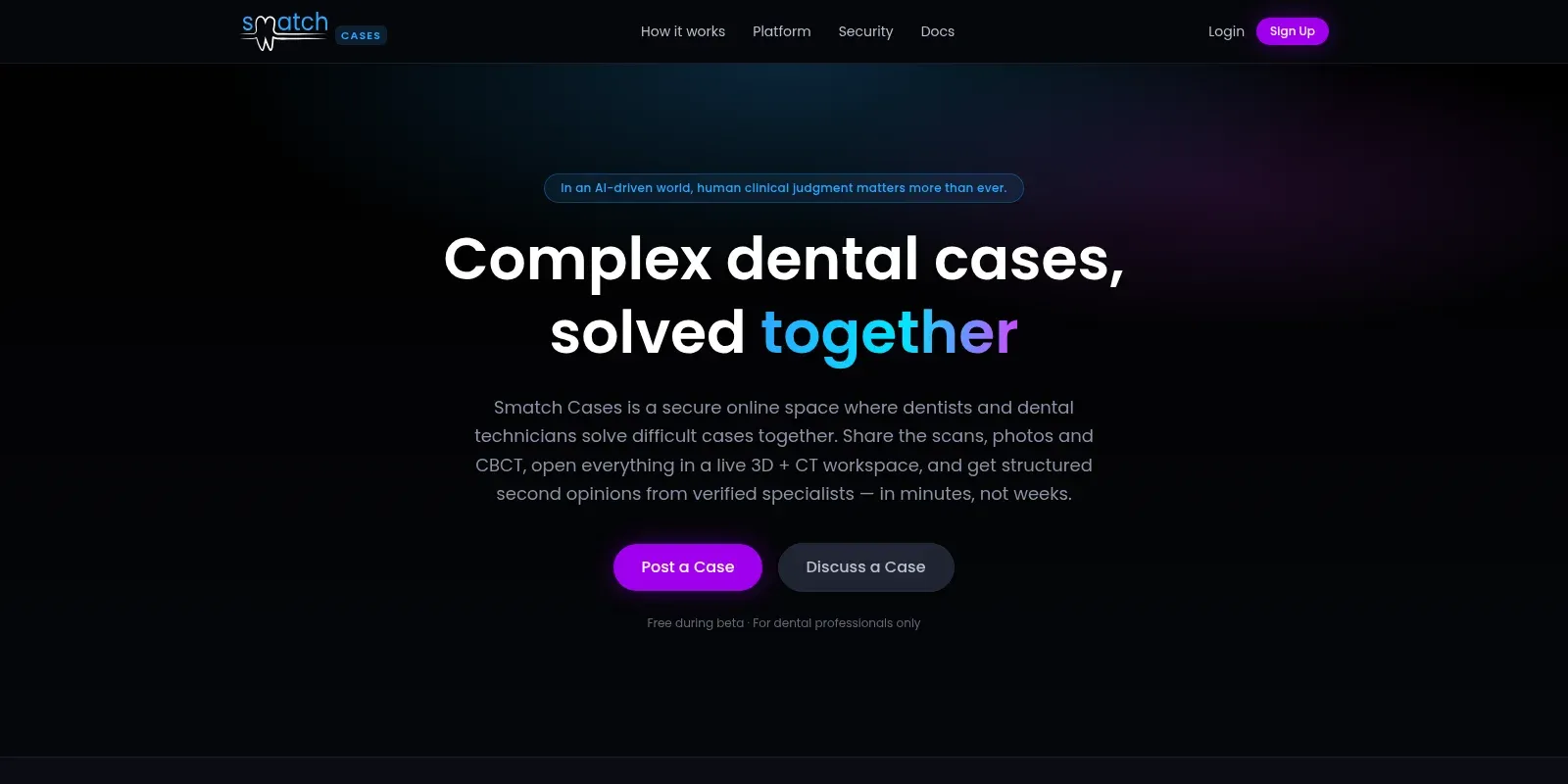
Smatch Cases — clinical case collaboration with a live 3D + CT workspace
A secure platform where dentists and dental technicians solve complex cases together: upload scans, photos and CBCT, open them in a layered 3D + CT viewer in the browser, and collect structured second opinions from verified specialists.
Next.jsReactThree.js / WebGLCBCT volume renderingView case study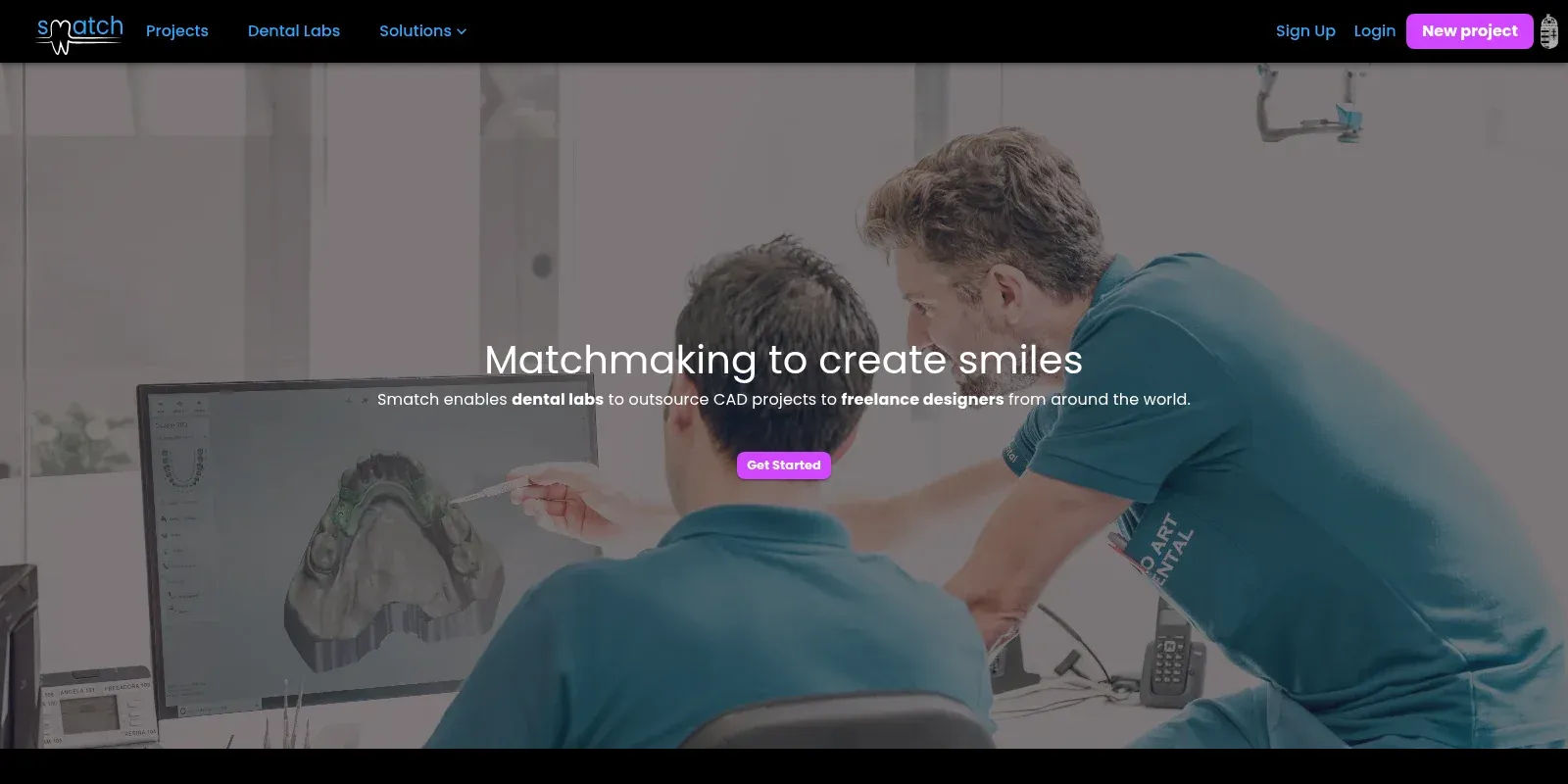
Smatch — global marketplace for dental CAD design
A two-sided platform where dental labs post CAD design jobs and freelance designers from around the world bid, deliver and get paid — with 3D preview, per-project chat and milestone payments.
Next.jsReactWebGL 3D previewStripeView case study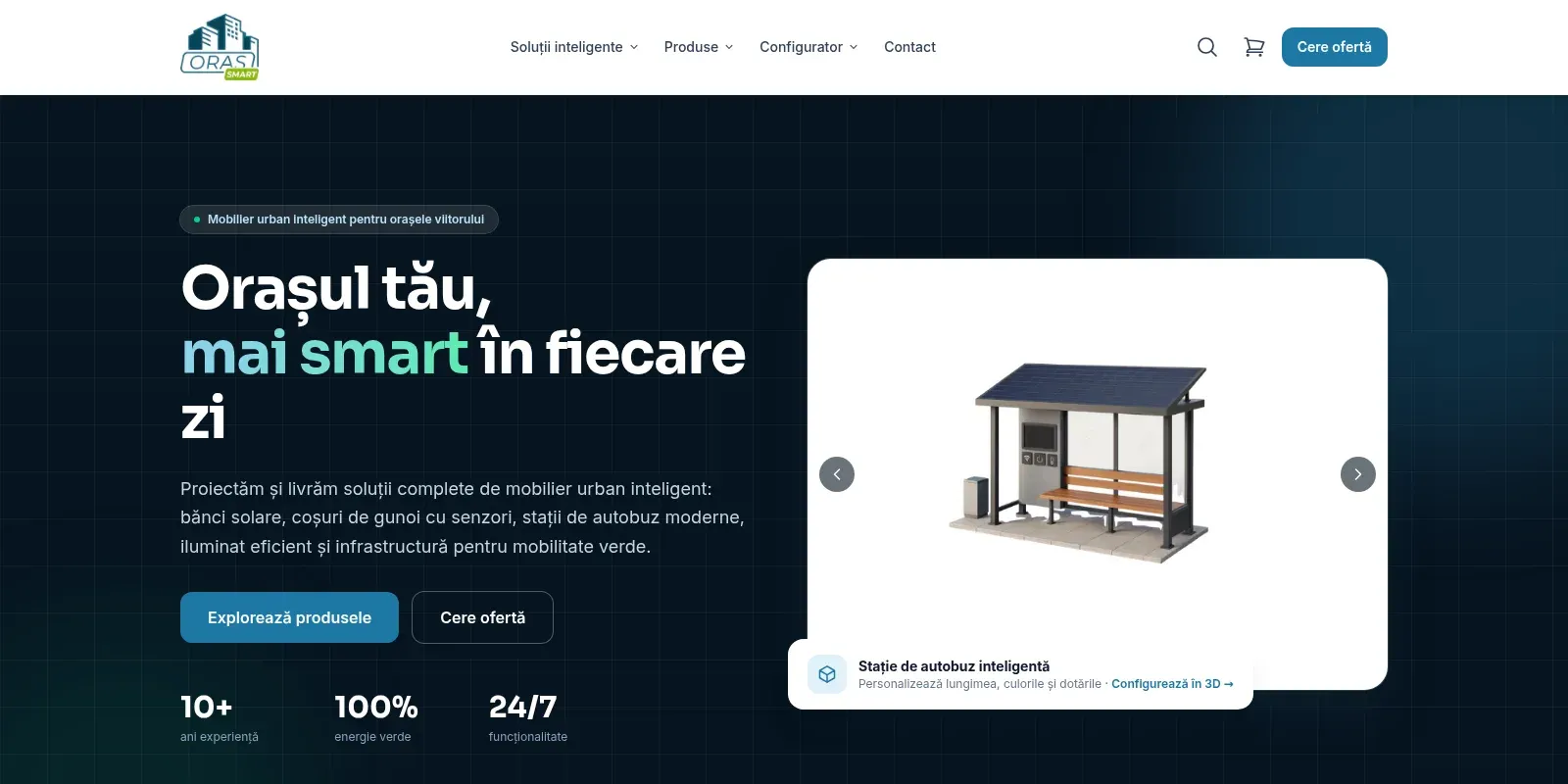
Oraș Smart — smart urban furniture catalogue with product configurators
Product platform for a supplier of smart urban furniture — solar benches, smart bins, bus shelters, lighting, bike parking, kiosks and video walls — with configurators for bus stops and benches, a placement planner and quote requests for municipalities and developers.
Next.jsReactHeadless CMSInteractive configuratorsView case studyRequest a quote
Describe what you need. The enquiry goes to our team, and we reply by email with the next step.